The Puzzle Heuristic: What Jack Skellington Taught Me About System Architecture
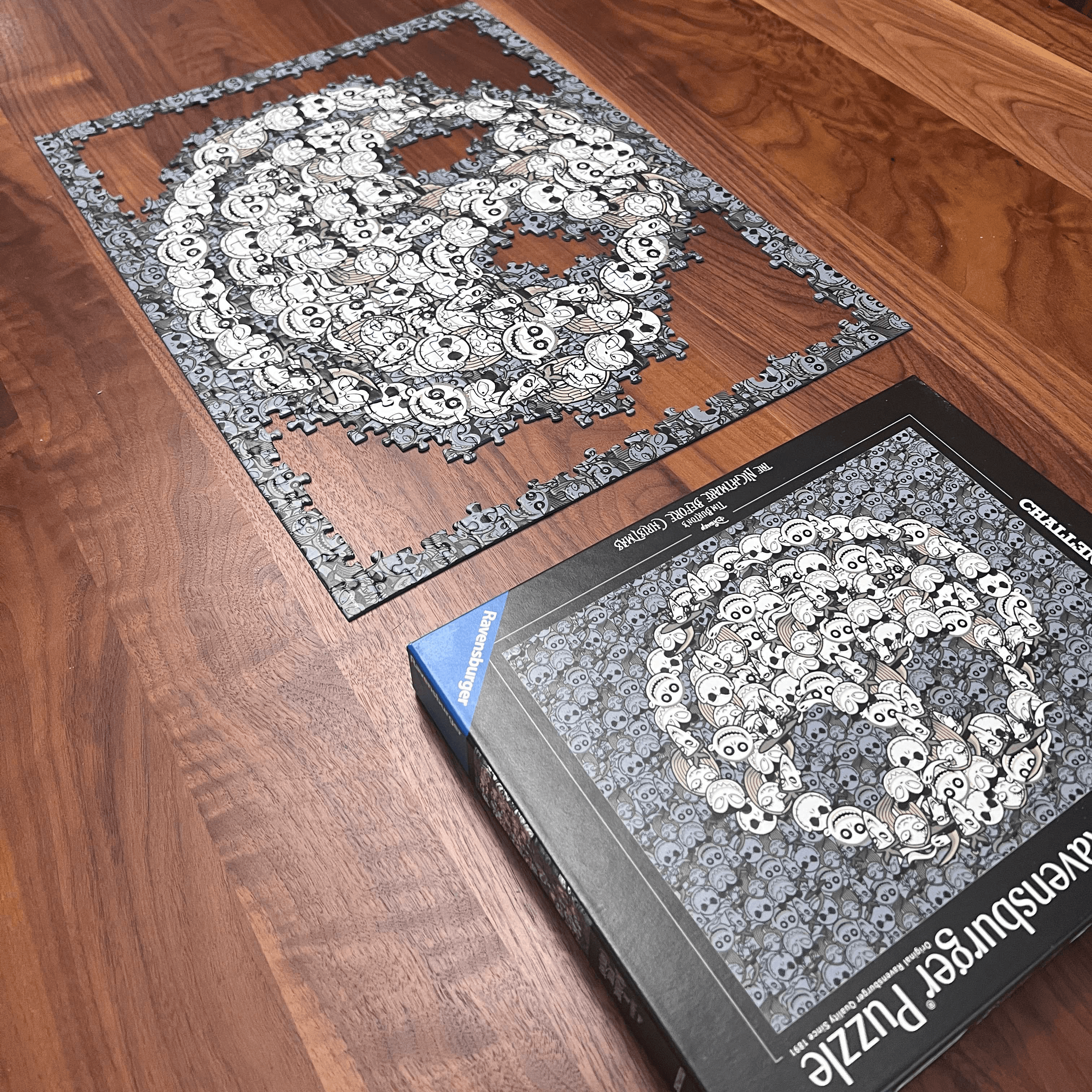
Over the holiday break, I received a 500-piece Ravensburger puzzle of The Nightmare Before Christmas. Jack Skellington, Sally, the whole Halloween Town crew.
I did what most people do: I dumped the box onto the dining room table. And immediately, I felt that familiar twinge of anxiety. A chaotic, incoherent pile of cardboard shapes.
It struck me that this moment is exactly what it feels like to start a massive Product initiative. You have the "Vision" (the picture on the box). And you have the "Reality" (500 scattered, disconnected pieces).
The gap between the two feels overwhelming. But as I started working, I realized that "puzzling" isn't actually about putting pieces together. It’s about sorting information. It is a perfect masterclass in Systems Thinking.
Here is the heuristic I used to finish the puzzle in record time—and how I apply the exact same logic to software design.
1. Find the Edges (Define Constraints)
The novice puzzler looks for "faces." The expert looks for flat edges. Why? Because edges define the boundaries of the problem. In Product, we often want to jump straight to the "cool features" (the faces). But effective leaders start by defining the edges:
What is the technical stack?
What is the timeline?
What are we not building?
By building the frame first, you create a contained space where chaos is manageable. You stop worrying about infinite possibilities and focus on the finite space inside the border.
2. Sort by Pattern (Component Libraries)
Once the frame was done, I didn't try to connect pieces. I just sorted.
Textured Black & Blue = The Background.
White = Jack's Face.
I wasn't solving the puzzle yet; I was creating a Taxonomy. In design, this is the equivalent of auditing your UI. You don't design a "Settings Page"; you audit your buttons, your inputs, your headers. You group similar problems together so you can solve them in batch. Solving a batch of 50 "white pieces" is faster than hunting for 1 specific piece in a pile of 500.
3. Modular Assembly (The "Component" Approach)
I didn't try to attach Jack's face to the border immediately. I built the border in isolation. I built the face in isolation. Then I built the background. Only when those distinct "modules" were complete did I try to connect them to the main frame.
This is exactly how scalable software is built. We build the "Checkout Flow." We build the "User Profile." We verify them independently, then we integrate them. If you try to force the connections before you build the components, you end up with spaghetti code (and a frustrated puzzler).
The Takeaway
Systems Thinking is just the art of reducing cognitive load. When you look at 500 pieces, your brain freezes. When you look at "Edges," "Whites," and "Black," your brain gets to work.
Whether you are building a SaaS platform or assembling Jack Skellington, the secret isn't working faster. It’s creating a system that makes the solution inevitable.
Date Published
Jan 5, 2026
Reading Time
3 min