Design in the AI Bubble: Stock Prices Will Fall, But Originality Goes First
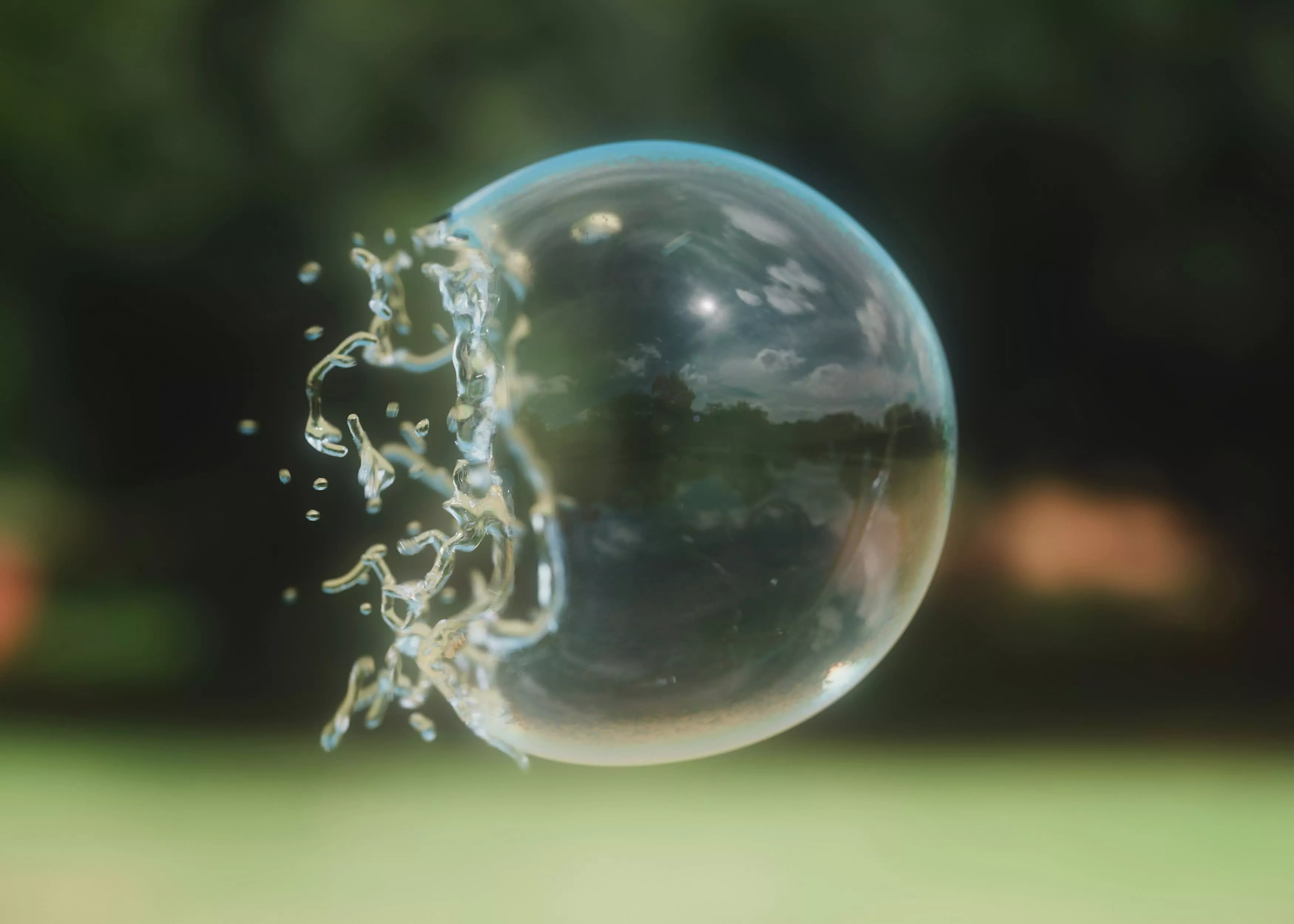
I asked AI when the AI bubble would burst.
It gave me charts, market scenarios, and a handful of polite caveats about “uncertainty.” What it didn’t give me was the thing I’m actually worried about: not just a correction in AI stock prices, but a correction in our collective patience for generic, automated work.
When people compare today’s AI boom to the dot‑com bubble, they usually talk about valuations. In the late 90s, we piled money into anything with a “.com” at the end of its name. A lot of those companies evaporated, but the infrastructure remained: the rails of the modern internet, new business models, entire industries.
I suspect AI will follow a similar pattern. Some players will disappear. Capital will cool. Underneath it all, useful tools and platforms will survive.
But there’s another “bubble” forming that we’re not talking about enough: the aesthetic and strategic bubble in design and branding created by automation itself.
The coming sea of sameness
Design automation tools promise instant logos, campaigns, and pitch decks. Give them a prompt and you get something that looks… good enough.
That’s exactly the problem.
When thousands of brands are pulling from the same models, the same prompts, and the same inspiration sources, the output begins to converge. Visual language flattens. Strategies blur. Everyone starts sounding and looking like everyone else.
We’ve already seen this with template-driven web design and no‑code site builders: the same hero sections, the same safe color palettes, the same “rounded card with drop shadow” UI patterns repeated across industries. AI is about to accelerate that pattern from “a lot of similar sites” to “a global sea of sameness” that touches every touchpoint—identity systems, campaigns, presentations, social content, product UI.
In a world where attention is scarce, looking and sounding like the average isn’t neutral. It’s actively harmful. It’s how brands disappear.
When sameness becomes a legal problem
If all we were dealing with was creative boredom, this would be annoying but survivable. The deeper risk is legal.
At scale, automated tools will produce branding and campaigns that are not just similar in vibe, but dangerously close in form. When thousands of companies are relying on similar prompts (“bold, modern tech logo,” “friendly DTC wellness brand,” “premium but playful fintech app”) you will inevitably get:
Logos with nearly identical forms.
Layouts and campaigns that echo existing work a bit too closely.
Taglines and copy that mirror competitors’ phrasing.
Today, when a human designer inadvertently comes too close to an existing identity, there are at least a few safeguards: discovery, process documentation, rounds of review. With AI, the volume and speed of output explode, while the visibility into “how we got here” shrinks. Most teams won’t know where their model-derived concept actually came from, or how closely it overlaps with work that’s already out in the world.
That’s a recipe for IP disputes.
I don’t think we’re far from the first high‑profile lawsuits around “AI‑generated branding that looks too much like X.” And when those arrive, the courts won’t be judging whether you used AI. They’ll be judging whether your mark or campaign creates confusion, infringes, or dilutes. The tool doesn’t stand in front of you in court. You do.
The hidden human effort nobody’s budgeting for
Here’s the irony: the more teams lean on automation, the more human effort they will need to keep their work original, strategic, and defensible.
That effort looks like:
Deep, up‑front strategy so you’re not just “making something pretty,” but building from differentiated positioning.
Taste, curation, and editing to sift through waves of AI output and identify what’s actually distinct, on‑brand, and worth developing.
Diligent research to check for conflicts, overlaps, and uncomfortably close similarities to existing marks and campaigns.
Clear documentation of process and decision‑making, so you can show how a direction evolved—and that it wasn’t simply scraped from a competitor.
Ongoing QA and brand stewardship to ensure subsequent AI‑generated pieces don’t drift into copycat territory.
In other words: the “time savings” we gain from spinning up instant ideas will be partially—sometimes entirely—spent on policing those ideas.
This is why “just prompt it” is not a strategy.
So, when does the AI bubble burst?
If we’re only talking about markets, the AI bubble will “burst” when expectations run ahead of reality long enough that investors flinch. The pattern is familiar from the dot‑com era: exuberant promises, spectacular wins, then a reckoning.
But in the world of branding and design, I think the bubble will burst earlier, and in a different way.
It will burst when:
Audiences stop paying attention because everything looks and sounds the same.
Leaders realize that their “fast and cheap” automated branding is costing them differentiation and legal exposure.
Teams discover that the work of avoiding sameness, infringement, and mediocrity is not optional overhead—it’s the core of the job.
At that point, we’ll see a re‑correction toward something more sustainable: AI as infrastructure and assistive tool, not as replacement for thinking. Automation will still be here, just like the internet is still here after the dot‑com crash. But the myth that you can automate your way to a meaningful brand will look as naïve as “eyeballs equal revenue” did in 2001.
What survives after the hype
What survived the dot‑com bubble wasn’t the buzzwords. It was the companies that paired new technology with real value, clear models, and thoughtful design.
The same will be true for AI.
The brands that make it through this era won’t be the ones who generate the most content or ship the most AI‑styled campaigns. They’ll be the ones who:
Use AI to explore, not to decide.
Invest in human judgment, strategy, and craft as their real moat.
Treat originality and legal defensibility as design requirements, not nice‑to‑haves.
So yes, I asked AI when its own bubble would burst.
Its answer was cautious and noncommittal. Mine is less polite: the creative bubble will pop as soon as we let automation replace the hard human work of thinking, choosing, and taking responsibility.
The good news is that we don’t have to wait for a crash to adjust. We can start designing with AI, not for AI—building brands that are unmistakably themselves, even in a sea of generated noise.
Date Published
Apr 22, 2026
Reading Time
7 min